

Air Sciences Inc. is collaborating with Brigham Young University graduate student Stephen Tyler on an expert survey examining the public-health implications of receding terminal saline lakes.
Terminal saline lakes occupy closed basins: water flows into them, but there is no river or other surface-water outlet to the ocean. Many occur in arid and semi-arid regions, where evaporation concentrates salts and minerals. These lakes are important ecosystems, supporting birds, other wildlife, local economies, cultural resources, and recreational uses.
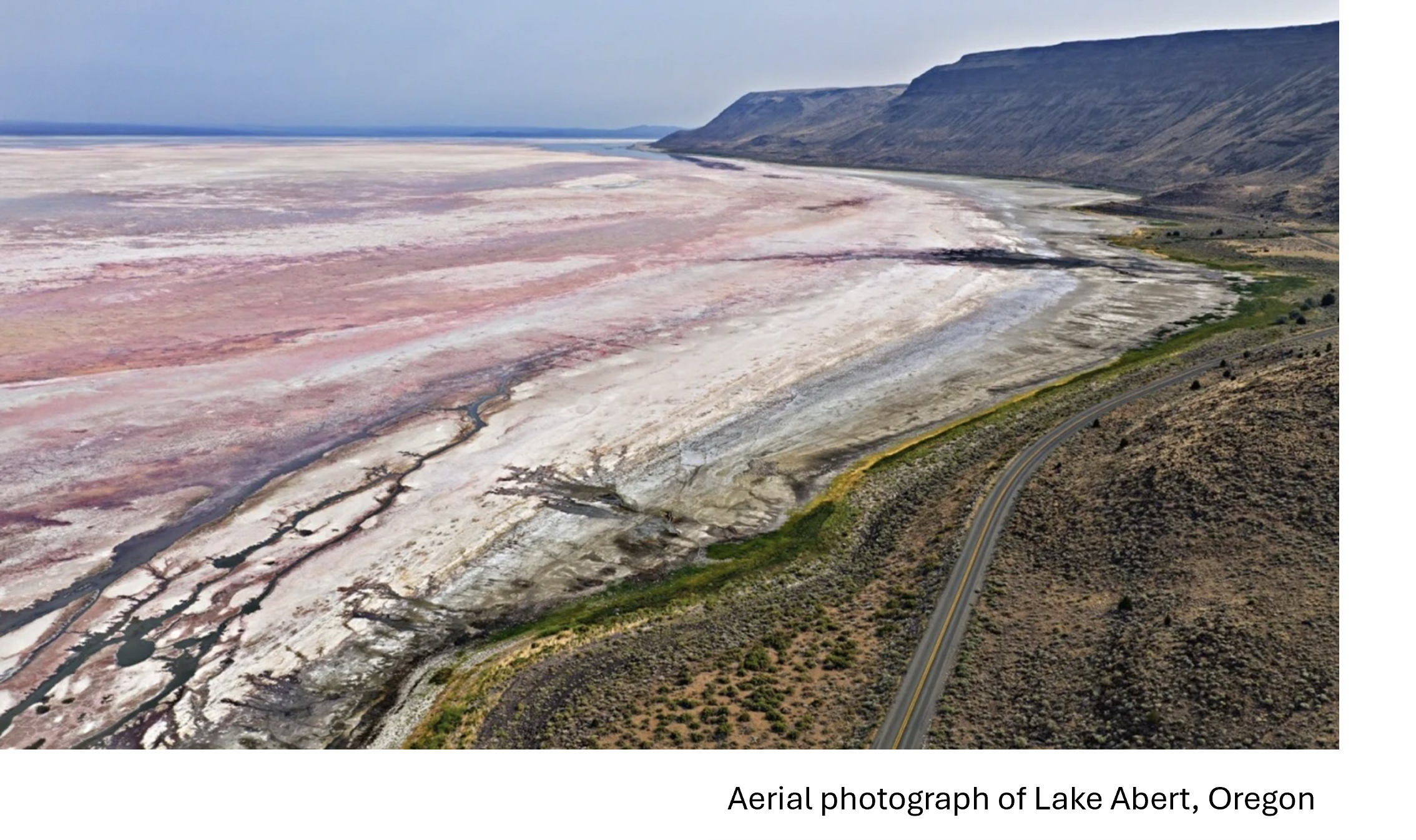
Many saline lakes are shrinking, and some have been largely or completely desiccated. In the United States, notable examples include Utah’s Great Salt Lake; California’s Mono Lake, Owens Lake, and Salton Sea; and smaller desert lakes such as Lake Abert and Summer Lake in Oregon.
Why lake recession matters for health
As lake levels fall, formerly submerged sediment is exposed as dry lakebed, or playa. Under windy conditions, playas can emit substantial amounts of airborne dust. This dust can contain fine particles that are harmful to breathe, along with concentrated salts and naturally occurring or human-derived contaminants. Depending on the lake and its watershed, contaminants may include arsenic, boron, selenium, and other elements.
Dust exposure can be a concern for nearby and downwind communities, particularly for people with asthma or other respiratory conditions, children, older adults, and people who work outdoors. Yet the amount, composition, transport distance, and health significance of dust vary substantially among lakes and remain incompletely understood in many locations.
Purpose of the expert survey
The survey asks scientists and other professionals with relevant expertise—such as saline-lake change, air quality, public health, toxicology, exposure science, ecology, and water management—for their informed professional judgments.
Expert assessment is useful when decisions must be made despite incomplete data. Rather than claiming to produce a single definitive prediction, the survey will characterize the range of informed views about:
- Potential public-health risks associated with saline-lake recession and exposed lakebeds.
- Major pathways of exposure, including windblown dust.
- Important uncertainties and research gaps.
- Possible mitigation and monitoring priorities for affected communities.
Respondents may answer only the questions that match their expertise. Those partial contributions remain valuable because the scientific uncertainties are substantial and the potential societal consequences can be large.
Confidentiality and timeline
The survey is expected to be completed in 2027. Results will be published as an anonymous dataset of estimates; individual responses will not be identified.
Contact us to learn how Air Sciences’ work on lakebed dust emissions and air quality monitoring can help communities and agencies prepare for the health effects of receding saline lakes.
